MWS Motorsport / Oil-to-water cooling

Control heat.
Free up space.

An oil-to-water mounting plate kit lets you position the heat exchanger where it fits your build, including close to the engine.

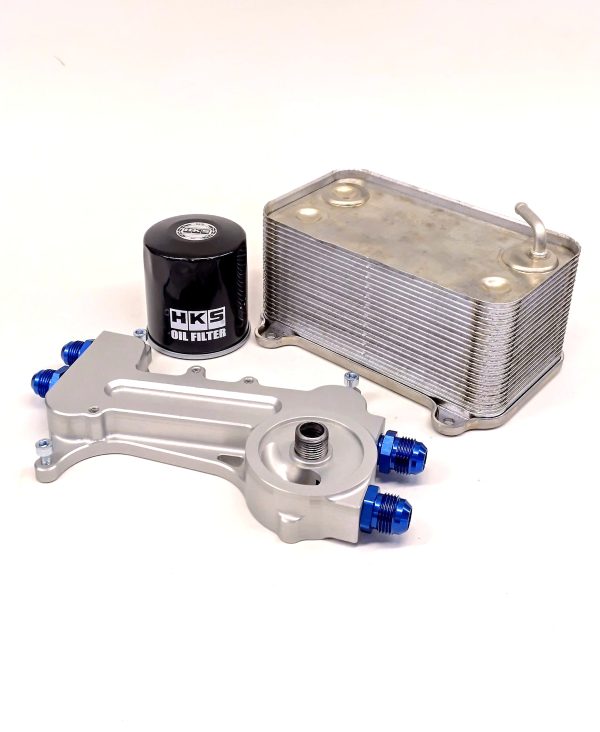
MWS Motorsport oil-to-water kit with integrated filter mount

Integrated oil-filter kit · Actual product photograph
01 / Built around the installation

When space and airflow
set the rules.

A conventional air-to-oil cooler needs a suitable supply of cooling air at its core. An oil-to-water heat exchanger transfers oil heat into the coolant instead, so the exchanger can be positioned where the installation works best.

01 / DRIFT & LOW ROAD SPEED

Less reliance on direct airflow at the oil cooler.

When road speed and vehicle angle make frontal airflow inconsistent, an oil-to-water layout can be a strong option. Pair it with a correctly sized radiator, effective ducting and fan control: the overall system still needs airflow to reject the heat.

02 / A CROWDED FRONT END

One less core competing for space.

Intercooler, radiator, condenser: the front of a performance car fills up quickly. Moving oil cooling into the coolant circuit can remove the need for a separate front-mounted oil cooler. The radiator must have capacity for that additional heat.

03 / REAR & MID-ENGINE BUILDS

Place the exchanger near the engine.

A compact water-cooled unit can simplify packaging and may shorten oil lines compared with a front-mounted oil cooler. Plan coolant routing, pump capacity, access and bleed points around the actual vehicle.

02 / The principle

Two circuits.
One heat transfer.

Oil and coolant flow through separate passages inside the heat exchanger. Heat passes through the metal between them, from the hotter fluid to the cooler fluid; the fluids do not mix in normal operation.

01 / OILEngine heat enters the oil.

Hot oil circulates through the heat exchanger.

02 / COOLANTHeat crosses into the coolant.

A temperature difference and adequate flow in both circuits drive heat transfer.

03 / RADIATORHeat leaves the vehicle.

The coolant radiator releases the combined heat load into the surrounding air.

Cooling is only half the story. When coolant is warmer than the oil during warm-up, heat can move in the opposite direction and help bring the oil up to temperature. This is not a fixed-temperature regulator: final temperatures depend on the complete system, load and operating conditions.

03 / Choose the right approach

Water-cooled or air-cooled?

The best solution is the one that fits the car’s heat load, available airflow and installation space. Oil-to-water cooling offers packaging advantages—not a universal promise of lower oil temperatures.

Design consideration Oil-to-water Air-to-oil
Exchanger location No direct airflow required at the exchanger. More freedom to place it near the engine. Core needs an effective cooling-air path, often at the front or in a dedicated duct.
Low-speed operation Can use a well-controlled radiator and fan system to reject oil heat. May need a dedicated fan or other provision when natural airflow is insufficient.
Coolant heat load Adds oil heat to the coolant circuit. Radiator capacity must be checked. Rejects oil heat directly to air. Stacked cores can affect airflow and radiator inlet-air temperature.
Warm-up Warmer coolant can help heat colder oil. Does not use coolant to warm oil; temperature control depends on the chosen thermostat and layout.
Installation Requires both oil and coolant connections, correct routing and careful bleeding. Requires oil connections plus suitable mounting and ducting for the cooling air.
04 / Choose your hardware

Oil-to-water mounting plate kits.

Choose from compact, standard and integrated oil-filter kits. Each pairs an oil-to-water heat exchanger with an MWS Motorsport mounting plate.

Integrated oil-filter kit

MWS MOTORSPORT / INTEGRATED

Integrated oil-filter kit

30 mm mounting plate with an integrated filter mount. Includes an HKS oil filter and four AN adapters in the selected configuration.

VIEW PRODUCT

Choose the complete system for your oil flow, coolant capacity and installation. Check current specifications and availability in the MW Steel shop.

05 / Engineer the whole system

Choose with confidence.
Validate on the car.

Tell us about your engine, intended use, available space and current cooling layout. We can help you identify the hardware to investigate for your build.

Discuss your installation ↗

  • Cooling headroom: confirm radiator, fan and coolant-circulation capacity for the added oil heat.
  • Oil flow and pressure: select line sizes, fittings and routing for the engine’s oil system and acceptable pressure loss.
  • Connections and control: verify port assignments, thermostat strategy, mounting, hose compatibility and bleed points before installation.
  • Measure under load: log oil and coolant temperatures and oil pressure in representative driving conditions.
Kit contents differ. AN fittings are not included in the compact or standard mounting-plate kit; the integrated filter kit includes the specified HKS filter and four selected AN adapters. Consult each product page before ordering.